Tuesday, April 9, 2013

4. Weighing: Which factor, national, regional or international is most important in managing terrorism?


National


National efforts to combat terrorism are the most important because national efforts help to define society’s stance against terrorism. For example, in the Taliban-Ruled Afghanistan, the Taliban encouraged the use of terror against the west, and even decided to hide Osama within Afghanistan. As a result, society would in turn accept such values and this will allow terrorism to grow. However, if governments define terrorism as undesirable and dangerous, society would think twice before accepting terrorists’ ideologies, especially if laws are enacted against acts of terror. When compared with International/Regional efforts, national efforts are much more effective as they can be legally binding and have a much more profound impact on society due to a close relation between national governments and the country as opposed to international bodies and the country. Therefore, national efforts to curb terrorism are the most important.

International

  International Cooperation to combat terrorism is the most important because international cooperation transcends borders. In an increasingly globalized world, terrorist organizations are networking with other organizations from distant countries to plan and execute attacks together. Furthermore, terrorists can often escape from a country into another country. This increases the needs for countries to cooperate with each other to bring down the network of terrorism. National efforts are insufficient as terrorists can move to other countries for safe havens. Even society’s efforts are not enough as only when nations exchange information with each other and work together can terrorism be effectively curbed.

What role can the UN, as a world body, play in fighting terrorism and how effective has it been so far in containing this scourge?


Terrorism can also be managed at an international level.

Role played by UN:
 In the wake of the September 11 attacks, the United Nations passed a series of resolutions, which was aimed at getting member countries to freeze the financial assets of terrorists and their supporters, deny them travel and safe havens, prevent recruitment and weapon supply, and cooperate with each other in information sharing and criminal prosecution. The UN also set up a Counter-Terrorism Committee to monitor the adherence of member states to the resolutions and strengthen the counter-terrorism capacity of UN member states. More than $200 million USD funds have been frozen and 4000 suspects arrested since.


International efforts are becoming even more crucial in the advent of globalization, which allows terrorist to maintain international networks and cooperate with other terrorist organizations at an international level. To combat such affiliations and cooperation, the international community needs to act as well, by freezing funds and choking weapon supplies to slow down terrorism. Only when countries cooperate to slow down terrorist activities can transnational terrorism be managed.


Effectiveness:
The effectiveness of the UN can be seen from specific case studies. We will be using the intervention in Afghanistan to show how the UN has been successful and its limitations. Afghanistan is a hotbed for terrorist activity, with the large number of terrorist training camps and presence of major terrorist groups such as the Taliban. The actions taken by the UN can be classified into 3 types. 

At first, the UN took measures to resolve the situation through dialogue. They condemned the terrorist acts of the Taliban and called for peaceful talks and for the Taliban to stop their terrorist activities. After this failed, the UN indirectly intervened through peaceful methods such as putting broad sanctions in place and freezing Taliban funds and financial resources. Lastly, the UN has resorted to direct military intervention in Afghanistan by establishing the International Security Assistance Force, which both trains Afghanistan security forces and combats insurgent groups in Afghanistan.

The intervention by the UN can be seen as effective in improving the terrorist situation in Afghanistan as negotiations with the Taliban have been making more progress in recent years, which can be seen from the US considering withdrawing their troops. However, the way the situation was managed also shows the politics which limit the actions of the UN. Direct military intervention was initiated by the US and can be seen as retaliation for the 9/11 attacks. However, they did so without waiting for a resolution or approval from the UN, and it is unclear whether this was actually the best action to take at that time due to the political climate after 9/11 affecting the decisions made by the US. This shows that the UN has limited power as a world body and influential countries such as the US may not follow its rules and regulations. 

How effective is ASEAN as a regional organization in the management of terrorism?


Terrorism can also be managed at a regional level. For example, ASEAN has implemented various steps to curb terrorism, such as pledging to enhance information and intelligence exchange on terrorists and terrorists’ activities. This has helped member states to disrupt terrorist activities on their soil. Furthermore, in January 2007, Southeast Asian leaders agreed to another raft of measures that committed their national security and law enforcement agencies to work closely to fight the threat together, such as the convention on counter-terrorism.

  Regional efforts to counter terrorism are important as transnational terrorism is not confined to any single state and it can operate in many different states at any one time. To effectively curb transnational terrorism, states must be willing to share intelligence with each other and work together to disrupt terrorist activities. The work of regional bodies such as ASEAN, while it is not binding, is a step to foster greater regional cooperation towards curbing terrorism.


Managing terrorism in Singapore


An prime example of terrorism being mitigated through efforts at a national level is Singapore. For example, the community engagement program launched by PM Lee on 9 February 2006 is a long term effort to ensure that Singaporeans are better equipped to maintain social cohesion and harmony, should a crisis happen in Singapore. It aims to bring Singaporeans from different communities together to strengthen inter-communal bonds.

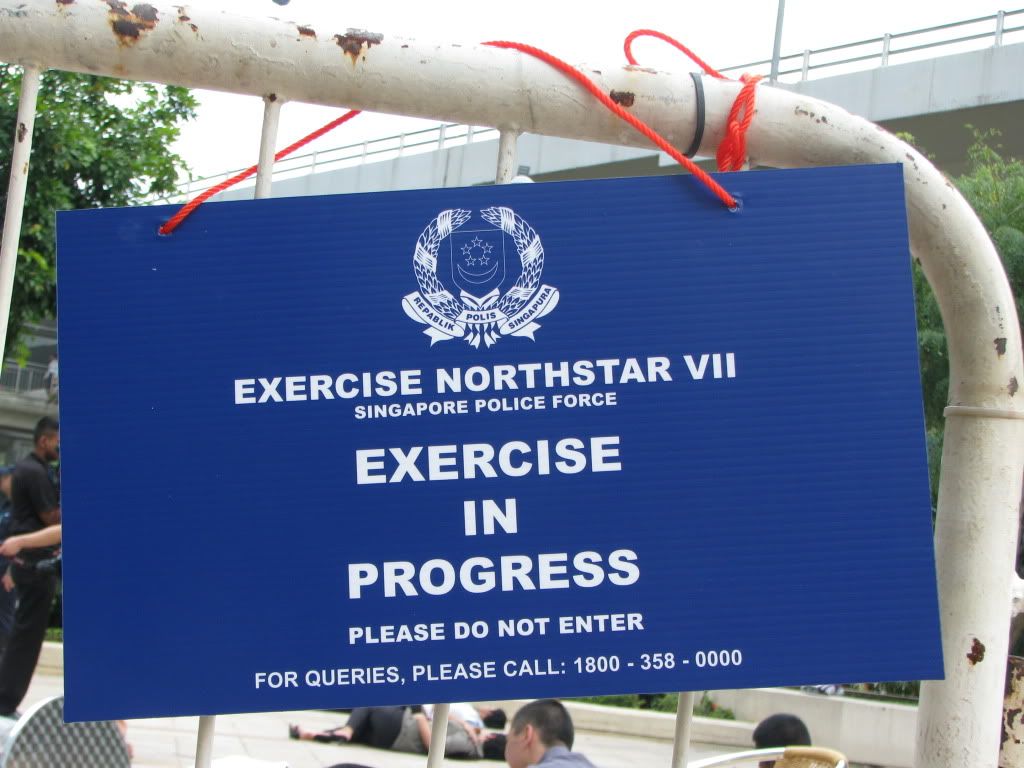
To counter terrorism, governments also need to work to implement frameworks for dealing with terrorist attacks. Apart from such plans mentioned above, the government also needs to develop emergency response plans to terrorist attacks, and conduct exercises to maintain public vigilance, such as exercise Northstar 
(Click link to find out more about exercise Northstar: http://news.xin.msn.com/en/singapore/article.aspx?cp-documentid=5581084)
conducted by the government to stimulate a terrorist attack. Only when the government is adequately prepared to provide the leadership to proactively prevent terrorist attack and respond quickly in crisis can terrorism be mitigated. Another initiative to maintain public vigilance is through reminding the public to be alert at all times through the media. The broadcasting of a clip at all MRT stations showing the bombing of Singapore's MRT and measures the public can take to avoid it is one key example.

Through efforts at a national level, the Singapore government has rather successfully managed terrorism in Singapore.


Managing terrorism within a country


National security:

  • Enhance security at important locations
  • Alarm systems
  • Emergency preparedness
  • Airspace and maritime patrolling


Nurturing environment that censures terrorism:

  • Terrorist narratives are typically founded on ideas of hate and enmity.
  • Stand against these ideas that fuel terrorism.
  • Every individual has role to play to deny terrorists space in society and prevent terrorist ideas from gaining legitimacy

Social cohesion:

  • Terrorists exploit racial and religious issues to create chaos and instability
  • Good communication between government and ethnic races is required
  • Racial and religious tolerance especially in multi-racial/ multi-religious countries.
  • Ensure integration into society, minimizing outliers who have a higher tendency to be recruited by terrorist organizations.
  • Prevent societal discrimination


Introduction


Terrorism, defined as the use of violence and intimidation to cause terror, has been around for centuries. However, a particular type of terrorism has been on the rise in the past few decades. The 9/11 attacks, 1995 Tokyo subway anthrax incident, and many others are all instances of this new form of terrorism - religious terrorism.

As its name suggests, religious terrorism is motivated by religion rather than political or social issues. Religious terrorists see violence as necessary to furthering their religious cause.  To them violence is a divine duty executed in response to theological demand and justified by scripture. They are thus unafraid of alienating supporters and are willing to use extreme and indiscriminate methods, unlike terrorists with political motivations. Religious terrorist organisations are often personality-driven and centred around one iconic leader.

As terrorism evolves, so does the methods used to manage and control the growth of terrorism. Our other posts will address exactly what methods are used, and case studies of ASEAN and the UN.


Examples of terrorism


Terrorist Organisation
Nature of organization
Cause(Ideology)
Notable attacks
Nature of ideology


Al-Qaeda
Radical Islamist movement
Extablishment of a global Islamic government (caliphate) based on extreme interpretations of Islamic Concepts.
(Side)Expel Western influence from Muslim countries, establish sharia law, uniting Muslims for “jihad”


Sep 11 Attacks
Pan-Islamism
Islamic Fundamentalism
Jemaah Islamiyah (JI)
Militant Islamic Movement
Establishment of a regional Islamic government (caliphate) incorporating Indonesia, Malaysia, Southern Philippines, Singapore and Brunei


2002 Bali Bombings
Pan-Islamism
Islamic Fundamentalism
Lashkar-e-Taiba (LeT)
Militant Islamist Organisation
Integration of Jammu and Kashmir with Pakistan after ending Indian rule in the state
Advocating Pan-Islamism in South Asia (Establishment of a caliphate in South Asia)


2008 Mumbai Attacks
Pan-Islamism
Islamic Fundamentalism
Liberation Tigers of Tamil Eelam
Insurgent Group
Establishment of an independent Tamil state in the North and East of Sri Lanka


Central bank bombing in Sri Lanka
Tamil Nationalism
Provisional Irish Republican Army
Insurgent Group
Overthrow British Rule in Northern Ireland


-
Irish Nationalism
East Turkestan Islamic Movement
Insurgent Group; Regional terrorist organisation
Establishment of an independent East Turkestan state in Xinjiang, China
Conversion of all Chinese people to Islam
Various attacks in China, including a bus bomb in Kunming and an attempt to hijack a plane in Urumqi


Pan-Islamism
Turanism (Political movement for unity and independence)
Hamas
Regional Terrorist Organization or government


Formation of a Palestinian state based on 1967 borders
-
Palestinian Nationalism
Earth Liberation Front
Eco-Terrorists
Protection of the environment
-
Environmental Conservation


Al-Shaabab
Insurgent Group
Establishment of a Islamic Somali State


-
Somali Nationalism
Chechen Separatists
Insurgent Group
Establishment of an independent Chechen Republic


1st & 2nd Chechen war

Wednesday, March 27, 2013

How effective is ASEAN as a regional organization in the management of terrorism?

(Using point form for the question posts, but use the information from google doc to make a script with sufficient explanation/examples)


     ASEAN has the responsibility as a regional organisation to facilitate terrorism management in member countries, and has been largely effective in doing so. ASEAN has done so through 

1. Enhancing information and intelligence exchange on terrorists and terrorist activities.
2. Fostering cooperation between member countries in order to deter and eradicate terrorism.
3. Acting as a regional organisation to cooperate with countries or organisations from outside the ASEAN region.

How can terrorism be managed within a country?

     Country authorities play an important role in preventing a terrorist act within a country. They do so by asdfasdfasdfasdf.

     However, the authorities also need the cooperation of the people. This is done by raising awareness of the threat posed by terrorism and the role of the public in managing terrorism. For example, civilians should report suspicious activity or items and can be provided with anti-terrorism training. This is essential as the trend observed is for terrorists to target high-traffic civilian areas. As the police cannot conduct surveillance for all civilian areas at all times, it is necessary for civilians to take action to prevent terrorist acts as well.